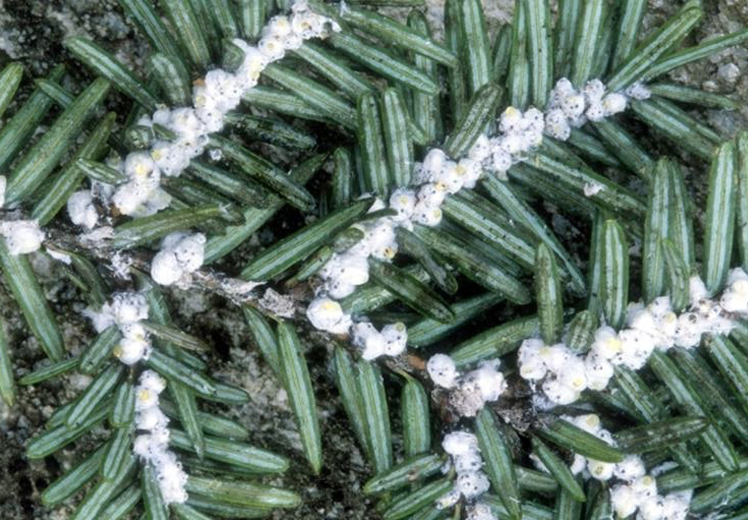
Hemlock woolly adelgid is an invasive species that is native to Asia and has been detected in Michigan, according to Michigan Department of Agriculture & Rural Development. These small, aphid like insects suck sap from hemlock twigs and can ultimately cause tree death.
Guest Column Article for Alpena News by Dr. Greg Corace of the Alpena-Montmorency Conservation District
The farther one goes north in Michigan the truer the saying, “We have two seasons: winter and bug season.” However, “bug season” is really a misnomer. We should call it “arthropod season,” but that doesn’t flow off the tongue so well.
Taxonomy is the structured classification of organisms. High school biology students are taught the sequential basics of Kingdom, Phylum, Class, Order, Family, Genus, Species. Finer taxonomic units are nested within broader units, similar to Russian wooden nesting dolls.
Arthropods are in the kingdom Animalia (like us!) and phylum Arthropoda (unlike us!) They are animals without backbones (invertebrates) and with tough exteriors (exoskeletons). In the phylum Arthropoda, many taxonomic orders exist. Bugs are in the order Hemiptera and have hard wings. Beetles are bugs. Insects have three body segments and are in the order Insecta. Black flies and mosquitoes are insects; so too are bees, moths, and butterflies. And ticks are in another group all together: Ixodida.
Together, the multitude of organisms found in these three orders comprise what most of us call bugs and that’s what we will call them here. While a few of these organisms are exotic invasive pests, forest biodiversity is driven in large part by bug diversity.
Most exotic and/or invasive bug species were unintentionally introduced through human activities. These species negatively impact many forests. Beech bark disease involves a non-native scale insect and threatens our American beech. Hemlock woolly adelgid is causing widespread mortality in eastern hemlock. Gypsy moth (now called spongy moth) stresses oak and aspen. And emerald ash borer is decimating upland and wetland ash species. When people speak of forest health, often it involves these and similar forest pests.
While the rate and magnitude of tree mortality is surely something forest conservationists need to pay attention to, death and decay are critical aspects of functioning forests. Tree mortality should be expected in a healthy forest and native bugs play an important role in tree death and many other ecological processes.
For instance, many native bug species have a positive (symbiotic) relationship with many plant species; without the bug, one doesn’t have the plant. Although most tree species are wind-pollinated, American basswood and black cherry and a few other species are pollinated by insects. Many other native shrubs and ground flora in forests are pollinated by bugs too.
The abundance and diversity of bugs is also associated with the diversity of migratory songbirds that return in the spring to breed and produce young in northern Michigan forests. Some of these bird species are short-distance migrants, while other species are long-distance migrants (often termed neotropical migrants). Our warblers, vireos, flycatchers, tanagers, sparrows, and blackbirds are all migratory birds. But why would they want to return north to breed?
One of the more compelling theories on why birds return north in the spring rests with the abundance of bugs. Bugs provide protein necessary for chick growth and maturation. And different bird species have evolved different foraging techniques for catching different types of bug prey. Some birds glean or simply pick bugs from vegetation or the ground. Most warblers glean. Other species, like many flycatchers, catch their food on the wing and return to a perch to wait for another bug to fly too close.
Unfortunately, not all species of bugs are doing well and this has potentially negative consequences for ecosystem sustainability. An article in the prestigious journal Science (24 April 2020) suggests that while some aquatic bug species are doing well, many terrestrial bug species have experienced significant and widespread declines in the last 30 years. The reduced diversity and abundance of many bugs may be linked to changing and intensified land uses and the homogenization of terrestrial ecosystems.
Forest landowners can promote native bug diversity by promoting native plant species, minimizing the use of pesticides, protecting unique sites on a property, and promoting forest complexity. For instance, seasonal wet spots, or vernal pools, provide breeding sites for bugs. These sites also provide breeding areas for many amphibian species, the young of which feed on bugs. Landowners should protect these sites and riparian zones from vehicular traffic and other land uses and establish forest buffers adjacent to them. Landowners can also promote forest structural and compositional diversity. Forests that have complex structure and layers of vegetation arising from different tree and shrub species of different sizes and shapes often have more bugs. From the forest floor to the utmost reaches of the forest canopy, these different layers provide conditions for different bugs and, conversely, other wildlife species that rely on them.
Greg Corace is the forester for the Alpena-Montmorency Conservation District. For more information, including sources used in this article, Greg can be contacted via email (greg.corace@macd.org) or phone (989.356.3596 x102).