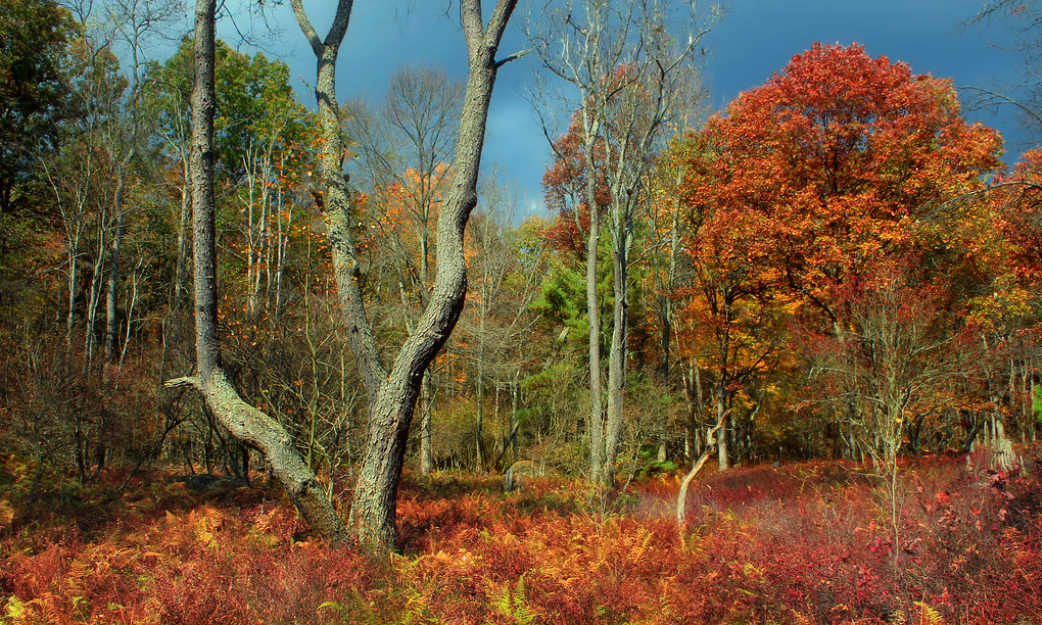
"Kunes Camp Trail (14)" by Nicholas_T is licensed under CC BY 2.0. To view a copy of this license, visit https://creativecommons.org/licenses/by/2.0/?ref=openverse.
Guest Column Article for Alpena News by Dr. Greg Corace of the Alpena-Montmorency Conservation District
August 2020
In any science-based endeavor a unique language comprised of words with specific definitions develops. These words convey specific meanings for specific purposes in specific contexts.
For natural resource conservation efforts to be successful, clear and concise communication that adheres to established definitions is important. Standard definitions allow professionals to communicate effectively with one another. Judicious use of terms and their definitions can also be used to educate the broader public regarding the natural world and our interactions with it. Conversely, loose terminology can cause confusion or misrepresentation or worse.
Forest ecology and management and Wildlife ecology and management have developed as separate, but related, professional fields. Much of the terminology developed by these professions over the past century is similar. Nonetheless, textbooks in these fields usually have a glossary of terms found in their last pages so that the transfer of knowledge is based on specific definitions.
Because science is dynamic and new words arise over time, professional dictionaries are also critical for organizing scientific language. For instance, The Dictionary of Forestry is a product of The Society of American Foresters. Across its different iterations this text has provided students and professionals definitions associated with forestry and related fields of study, including wildlife ecology and management.
Scientific dictionaries provide surprisingly detailed definitions for words the general public find relatively mundane. For instance, Merriam-Webster’s definition of forest is: “a dense growth of trees and underbrush covering a large tract.” The Dictionary of Forestry defines a forest as: “an ecosystem characterized by a more or less dense and extensive tree cover, often consisting of stands varying in characteristics such as species composition, structure, age class, and associated processes…”
While previous articles in this column have repeatedly defined composition as the suite of plant species found in a forest and structure as the horizontal and vertical arrangement of vegetation, I have never defined an ecosystem. According to The Dictionary of Forestry, an ecosystem is: “a spatially explicit, relatively homogenous unit of earth that includes all the interacting organisms and components of the abiotic environment within its boundaries.”
Thus, forests, by definition, are much more than just trees (“woody perennial plants”) or timber (“wood, other than fuelwood, potentially useful for lumber”).
But how does all this affect the private forest landowner and conservation?
Firstly, definitions are important in planning.
Good planning leads to good management and effective conservation. Based on definitions provided above, forest planning should be a holistic enterprise with the ecosystem concept at its core. While very specific forest outputs may be of consideration in a management plan, forest planning should characterize a forest and all its components first and foremost. Forests may contain timber, for instance, but forests are not solely timber and a timber management plan is not a forest management plan.
Secondly, definitions are important for on-the-ground forest management activities.
Silviculture is, “the art and science of controlling the establishment, growth, composition, health, and quality of forests…” In its most simplistic form, silviculture is broken into actions that either regenerate the forest or enhance the growth of trees (some overlap exists, of course).
For instance, select cut is a term commonly used to characterize a forest harvest type that impacts forest growth and composition. While this is not a term defined by The Dictionary of Forestry, select cut is commonly employed to represent a treatment (harvest) in a forest that does not remove the majority of the living trees. Because this harvest type seems to be less severe than other treatment types, some think select cut inherently equates to good cut. Unfortunately, this is not necessarily the case.
If a select cut, for instance, entails the removal of only the most valuable trees, or the largest trees, or trees that remove the representation of a native species, a select cut is really a high grading treatment. And high grading is defined as, “the removal of the most commercially viable trees…. often leaving a residual stand composed of trees of poor condition or species composition.” The result of some select cuts, therefore, is a forest that is genetically less vigorous, with long-term adverse implications.
Many studies have shown that private, non-industrial, forest landowners have interrelated and complicated ownership goals. As such, forest planning and management need to be nuanced and reliant on clear communication. For forest conservation on these and other lands, adherence to definitions and an understanding of the dynamic nature of science are therefore required. While jargon can impede communication and should be avoided, professionals and those they serve should still adhere to established definitions to facilitate forest conservation.
Numerous forest-related dictionaries can be found on the internet; here is one example: https://dnr.maryland.gov/forests/Pages/gloss.aspx
Greg Corace is the forester for the Alpena-Montmorency Conservation District. For more information, including sources used in this article, Greg can be contacted via email (greg.corace@macd.org) or phone (989.356.3596 x102).