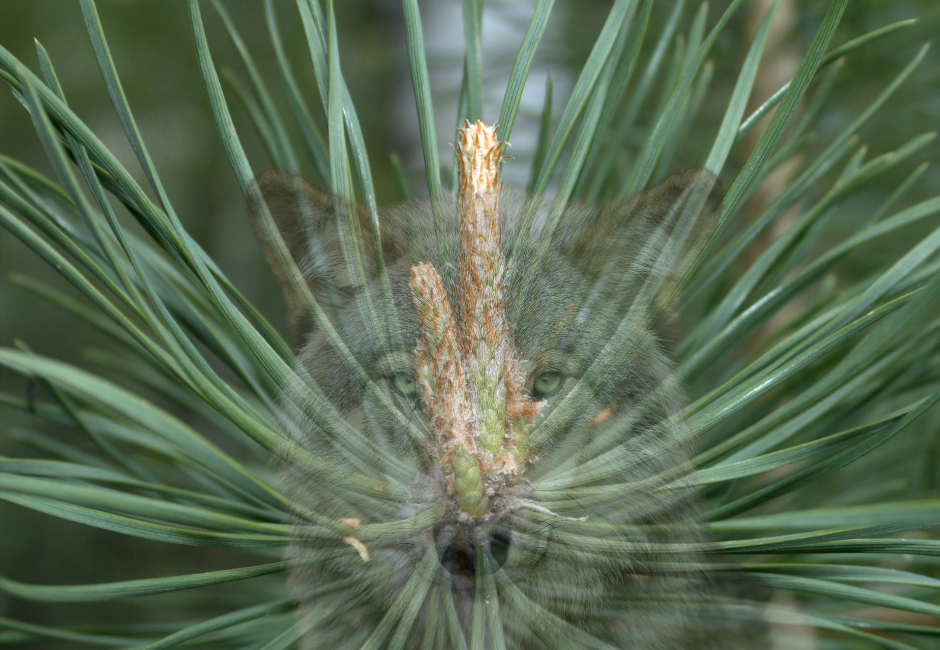
Image of gray wolf face (@Karl Umbriaco via Canva.com) superimposed on close-up of Scotch pine branch tip (@Chushkin via Canva.com) by Frechette.
Guest Column Article for Alpena News by Dr. Greg Corace of the Alpena-Montmorency Conservation District
Our views on different plant and animal species change over time. As an extreme example, the gray wolf was extirpated from mainland Michigan by direct human efforts in the mid-20th century. Wolves, it was broadly thought, were bloodthirsty monsters. Decades later, as the wolf population recovers, the important role wolves play in ecosystems as “keystone species” has been documented numerous times. Rather than being all “bad” or all “good”, predation is an important process in the dynamics of prey populations. Nonetheless, attitudes about wolves still differ among Michiganders.
Nonnative plant species can also bring about an array of opinions. For instance, throughout the late 20th century, autumn olive was promoted by federal, state, and local government agencies, as well as non-profits and special interest groups. Autumn olive was touted to stabilize soils and provide fruit for wildlife. It did both, while also aggressively outcompeting native plants for growing space. It is likely that more time and money are now spent on management to reduce the dominance of autumn olive than were ever spent on promoting its establishment. To many, autumn olive went from being wanted to being loathed in just a few decades.
Less dramatically, some nonnative tree species may be following a similar popularity pattern. Scots (or Scotch) pine, for example, is one of the more widely-distributed native pines of Eurasia. In Michigan, plantings of this nonnative species date back to at least the 1880s at the W.J. Beal Tree Plantation in Grayling (2004, Forest Ecology and Management, 189:171-187). This plantation was named after the professor who planted stems of 41 tree species, including 16 nonnative species, to document their growth potential on the sandy, droughty soils of the area.
When the plantation and adjacent “old field” were evaluated over 100 years later (1998-2000), none of the planted 32 deciduous (leaves drop in the fall) trees had survived. Conversely, coniferous (cone-producing) species such as Eastern white pine and red pine showed good growth potential, with two nonnative species illustrating invasive tendencies: Scots pine and Norway spruce regenerated on their own well away from the plantation in the “old field.”
The authors of the paper stressed that the results illustrated a need for caution when planting nonnative species. Moreover, they argued that—where possible—nonnative species should be managed to reduce their abundance and their potential for spreading to native ecosystem types.
The good news for those wishing to reduce the abundance and dominance of both Scots pine and Norway spruce is that neither species vigorously resprout. Unlike many deciduous tree species (e.g., maples, oaks, aspens) these coniferous species can be cut below the lowest branches, at ground level, and left alone. Over time, the remaining above-ground and below-ground plant material will die. In areas with a mix of mature trees, saplings, and seedlings, two strategies for management exist: start cutting from the edge of the infestation and move inward, or cut the most mature trees first (thereby limiting seed production) and the youngest seedlings last.
Our understanding of—and our interaction with—the natural world will continue to change. Learning from past treatments and adapting our approaches based on the best available science are critical steps in an evidence-based approach for conducting future planning and management. In most instances, native plants are the best choice when considering artificial regeneration. Besides landowner goals, plant species should also be selected based upon their suitability to specific ecosystem types, soil texture and moisture levels, and the present and future climate of a site.
Dr. Greg Corace is the forest and wildlife ecologist for the Alpena-Montmorency Conservation District. For more information, including assistance with the Qualified Forest Program and related forest planning and management, email Greg: greg.corace@macd.org.