
Answering Questions Requires Data
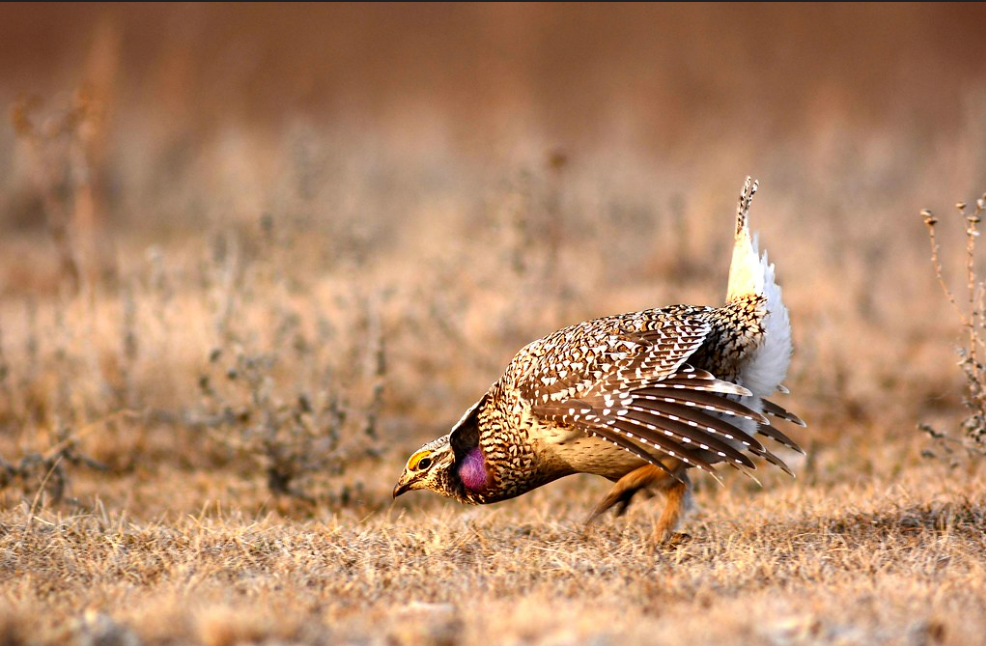
"Sharp-tailed Grouse on Lek" by USFWS Mountain Prairie is licensed under CC BY 2.0.
Guest Column Article for Alpena News by Dr. Greg Corace of the Alpena-Montmorency Conservation District
For many forest landowners in northeastern Lower Michigan, the November firearm deer season is the high point of the year. For this writer, forest landowner, and deer hunter, November represents a month with seemingly too few hours of sunlight and too many things to do. Consequently, instead of butchering my own deer this year, I took advantage of a local professional to cut and wrap my venison. The conversation with the butcher and subsequent discussions with colleagues spurred me to write this article.
During the 2022 hunting season, the Michigan Department of Natural Resources instituted an online reporting system associated with the harvest of deer in Michigan. Hunters are asked questions regarding sex of the deer, number of points, date of harvest, location of harvest, etc. All told, it took me 5 minutes to complete the reporting.
Why would the State of Michigan institute such a requirement?
A biological inventory is a systematic attempt to document the presence or abundance of an entity of interest; an inventory is a count. Determining how many deer were harvested in a given area may be considered an inventory. Monitoring, on the other hand, is the systematic evaluation of changes in a given parameter associated with an entity of interest. Yearly counts of the number of deer harvested, conducted over time and in the same way, is a monitoring exercise.
To be clear: neither inventory or monitoring, by themselves, constitute science in the strictest sense. As such, the moniker “citizen scientist” is a misnomer. While data collected during an inventory or through monitoring can be used to conduct science, the actual process of science requires the analysis of data and the publication of findings in refereed journals. Science requires critical “peer review” where subject matter experts not known by the authors evaluate the quality of the work done and determine whether or not the findings add to our state of knowledge and should be presented in scholarly outlets.
Designing defensible inventory and monitoring projects can be a scientific exercise, however. Many papers in scientific journals are devoted to improving inventory and monitoring programs. For instance, to monitor sharp-tailed grouse, spring “lek” or “dancing ground” surveys are conducted by multiple organizations and agencies. To evaluate the effectiveness of established protocols and improve data quality, a 2018 paper in the Journal Fish and Wildlife Management (volume 9, pages 666-676) determined factors that drive differences in counts between paired observers stationed the same distance from birds and counting at the same time in Michigan and Minnesota. Recommendations were made to simplify protocols by only reporting the total number of birds observed, not trying to ascertain sex. The scientists also suggested that training be required and optical equipment be used. Science improved the monitoring that should inform sharp-tailed grouse management.
To conduct evidence-based natural resource management, agencies and other organizations must lean on the best available science and high-quality data. While political, social, and economic issues certainly come into play, natural resource management is grounded in science. And science starts with the collection of defensible data, sometimes gleaned through inventory and monitoring exercises.
Unfortunately, the scientific community has often done a poor job of communicating how science works and the role of science in everyday life. Moreover, many agencies and institutions have moved away from employing scientists, resulting in isolated pockets of scientists within academia and a few other places.
To deal with 21st century challenges in forest and wildlife conservation we need more high-quality data, not less. Yes, this may mean that some inconveniences may arise due to reporting requirements. Rather than complain about the 5 minutes required to conduct these tasks, however, we should be asking that high-quality data be used to answer relevant research questions that are communicated via the peer-reviewed publication process and subsequent education and outreach to the public.
We need a revitalization of a culture of science throughout our society, including within the realm of natural resource management.
Greg Corace is the forest and wildlife ecologist for the Alpena-Montmorency Conservation District. For more information, including assistance with forest planning and management, email Greg: greg.corace@macd.org.