Planting Seedlings (Part 1)
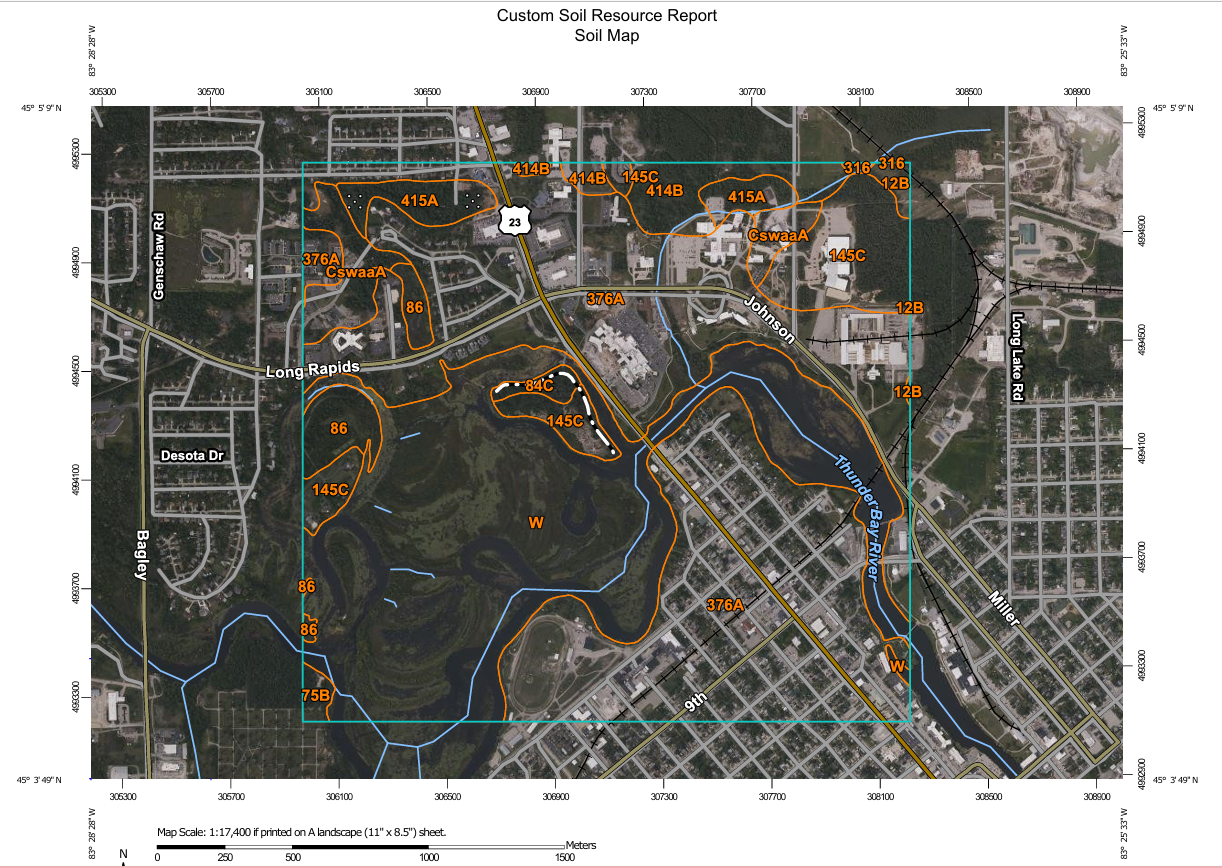
By customizing your Area of Interest (AOI), you can download a Custom Soil Resource Report, including soil maps, for free from the USDA/NRCS Web Soil Survey.
Guest Column Article for Alpena News by Dr. Greg Corace of the Alpena-Montmorency Conservation District
It is never too early to start planning. For forest landowners, the New Year stimulates thoughts of management activities to be accomplished in the next 365 days, including the planting of tree seedlings. This two-part series will cover steps involved in successful artificial regeneration (i.e., planting tree seedlings). Topics covered will include determining appropriate tree species relative to soil types, shade and moisture tolerance, planting methods, and the important issue of protecting seedlings.
The first step in artificial regeneration involves an acknowledgement of the opportunities and limitations imposed by soils. From excessively well-drained, nutrient-poor sands to richer, more moist loams and clays, soils dictate which native tree species theoretically thrive on a site. I write “theoretically” because there are other factors at play, including herbivory by white-tailed deer and elk that can shape a forest dramatically. Preferred browse species (e.g., aspens, oaks, maples, birches, some conifers) are often eliminated from the seedling and sapling layer, while species less likely to be browsed flourish (e.g., ironwood, American beech, balsam fir).
What do soil maps tell us?
Different tree species are adapted to soils with different textures, nutrient levels, and moisture-holding ability. Some species flourish on poorer soils; some are adapted to better soils. Some species prefer dry ground; some prefer wetter ground. Soil maps are the best way to determine this information and forest professionals can provide such information readily.
That said, our eyes also tell an interesting story.
The mix of forest and agriculture is readily observed in northeastern Lower Michigan. Those sites currently in agricultural use often have the best soils. Early settlers could ascertain from the type of forest growing on a given site whether or not the soils were appropriate for agriculture. Sites with our better soils historically grew northern hardwoods comprised of sugar maple, yellow birch, American beech, and white ash, with scattered Eastern hemlock and Eastern white pine. Many of these sites were cleared and converted to agriculture. Agriculture usually failed on sites with poorer soils and growing either lowland coniferous forests of black spruce, tamarack, and northern white-cedar or dry, upland sites of jack pine and red pine. Many of these latter forest types dominate our local public lands for this reason.
How about sunlight levels?
All green plants require sunlight to complete photosynthesis and produce the sugars they use as energy. However, some species require more sunlight than others. Those tree species that require less sunlight are termed “shade tolerant”, with tolerance existing (as most things do) on a gradient. More shade tolerant species (those that can exist in a forest understory with significant shade) include balsam fir, black spruce, American beech, ironwood, and sugar maple. Those species that require high sunlight levels (less shade tolerant) include paper birch, cherries, aspens, red pine, and jack pine. Mid-tolerant species include yellow birch, oaks, and Eastern white pine.
How about soil moisture?
In a similar way, tree species exist on a gradient of moisture tolerance. Some trees flourish in wetter sites that may be seasonally impounded by water (hydric): northern white-cedar, tamarack, black spruce, black ash. Other tree species typically do best on our drier sites (xeric): black and northern pin oak, red and jack pine. Then there is another group of tree species that fall in between (mesic): sugar maple, yellow birch, black cherry, American beech, American basswood, white spruce. Species like red maple and Eastern white pine are exceptionally adaptable and may be found across a broad range of sites.
Knowing soil types and sunlight and moisture levels determines which native tree species are best adapted to a given site. Forest management plans often provide landowners with detailed information about soils for this reason. Local professionals with your Conservation District and the Natural Resources Conservation Service can also provide advice. For the majority of planting activities involving native species, one does not need to test soil pH or micronutrient availability; available soil maps provide most of the necessary information.
Greg Corace is the forest and wildlife ecologist for the Alpena-Montmorency Conservation District. For more information, including assistance with forest planning and management, email Greg: greg.corace@macd.org.