Stepwise Forest Planning & management
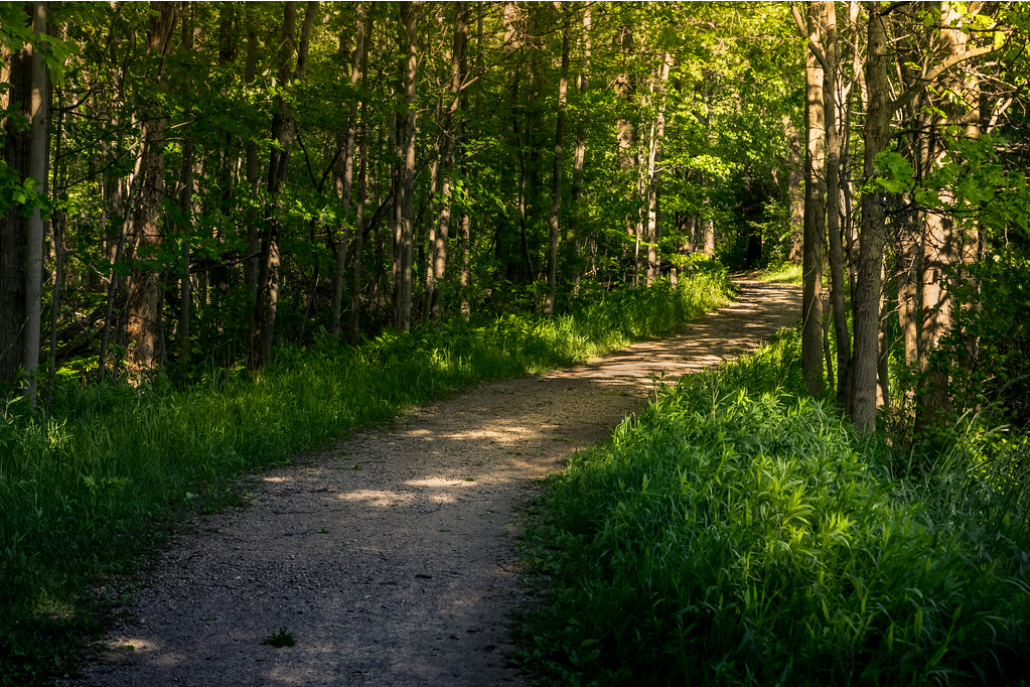
"sun-dappled pathway" by Christian Collins is licensed under CC BY-SA 2.0.
Guest Column Article for Alpena News by Dr. Greg Corace of the Alpena-Montmorency Conservation District
Forests are more than trees and produce more than a crop of timber products. Forests are biologically and ecologically complex ecosystems comprised of living and non-living components. Each forest is different and each forest requires unique planning and management to meet specific ownership goals and maintain ecological sustainability. That said, many forest landowners are unaware of the step-by-step actions involved in forest planning and management.
What is a forest management plan?
Forest planning is the process of evaluating both landowner goals (values) and the environmental characteristics of a property, and then developing objectives (measurable actions) to achieve the established goals. Planning, therefore, requires time so that the range of landowner goals can be discussed and evaluated among each other and within the context of the environmental conditions of the land. In most instances, some tradeoffs exist among goals; it is often difficult to have one’s cake and eat it too. Ranking goals, and understanding their interactions, are therefore necessary.
Information commonly found in a forest management plan includes the following: opportunities and limitations based on soil types and topography, information regarding the past, current, and future vegetation and wildlife at stand and landscape scales, important ecological processes such as fire and hydrology, invasive plants, animals, and pathogens, and a list of proposed actions (objectives) to achieve goals.
In Michigan, most forest management plans are written by professionals in the private sector. Planning, therefore, costs money. Fortunately, a few government programs (e.g., Forest Stewardship Program) can provide cost-share to reduce the cost of a plan. Conservation District foresters (such as the author) can provide free guidance and advice.
If a forest management plan includes recommendations for a timber harvest, this plan may be used to enroll a property of 20 acres or greater into the Qualified Forest Program. The Qualified Forest Program, run by the Michigan Department of Agriculture and Rural Development, has specific requirements that, when met, reduce the landowner’s property tax burden. Access by the public is not allowed and no other property rights are given away.
A forest management plan may also be used to apply for competitive Federal funds through agencies such as the U.S. Department of Agriculture Natural Resources Conservation Service. Tree and shrub planting, road work, assistance with timber harvests, and other activities have the potential to receive funding.
Forest management plans usually have a lifespan of 20 years after which changes in science, environmental conditions, ownership goals, timber markets, and government programs are re-evaluated through a new plan.
How is a timber sale accomplished?
While a long-term relationship between a landowner and a forest management plan writer is preferred, this is not always the case. A plan writer may be different than the forester that oversees plan implementation.
For instance, consulting foresters can function as plan writers and/or oversee timber sales outlined in plans written by others. They are employed by landowners in ways similar to lawyers, accountants, and other professionals: they see to the landowner needs and are paid either an hourly rate or a proportion of timber sale proceeds. The consulting forester determines the amount and quality of timber on the property, develops harvest stipulations/expectations in a logging contract, and advertises the harvest to loggers who buy the timber, cut the selected trees, and take logs to mills. The consulting forester then oversees all actions on the ground, including haul road layout and log landing identification, and holds a security bond from the logger in case any problems arise. Studies have indicated that working with a consulting forester usually leads to greater landowner post-harvest satisfaction.
As stated above, forests are complex. Forest planning and management should therefore not be rushed, but proceed in an orderly, step-wise fashion. It can take a year to develop a forest management plan and years to complete a timber harvest if weather is problematic or timber markets change. Patience, and a willingness to communicate clearly, increase the likelihood for success in any forest planning or management activity.
Greg Corace is the forest and wildlife ecologist for the Alpena-Montmorency Conservation District. For more information, including assistance with forest planning and management, email Greg: greg.corace@macd.org.