
Oak Decline
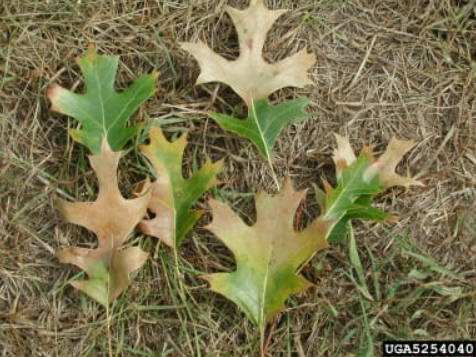
Wilt pattern in oak leaves, image courtesy of Joseph O’Brien, USDA Forest Service, via Michigan DNR
Guest Column Article for Alpena News by Dr. Greg Corace of the Alpena-Montmorency Conservation District
Previously, I introduced the reader to native oak species of northeastern Lower Michigan, their associated ecosystems, and how alterations to the landscape throughout the 20th century produced current forest conditions. Herein, the concept of “oak decline” will be discussed through a review of three research papers. Suggestions for mitigating the impacts of oak decline will be briefly presented, with more details in subsequent installments.
Oak decline is a broad-scale condition whereby many stressors of oaks act individually or in concert to cause mortality of mature trees and also limit recruitment of new individuals. Oak decline is occurring on most continents in which the oak genus can be found: Asia, Europe, and North America.
What are some of the drivers of oak decline?
As stated in a Forest Ecology and Management paper (2015, v. 354, p. 190+), primary factors to oak decline include outbreaks of native and/or non-native insects, drought, and/or damaging frost. These factors initiate decline events by weakening trees physiologically, often through defoliation. Secondary factors, such as bark beetles, wood boring insects, and fungal root pathogens (such as that causing oak wilt), then push trees over the edge.
A review paper in BioScience (2022, v.72, p. 333+) further supported the contention that while many insects, including spongy moth and multiple species of oak borer, stress or even kill adult trees, other factors are at play as well. Moreover, the authors note that the shifting patterns of sporadic wetness and drought are potentially making the impacts of these biological pests (primary and secondary factors) even worse. Changing weather patterns may promote soil pathogens and make trees more susceptible to stressors.
While oak decline usually refers to the overall reduced dominance of oaks as a species group, some individual oak species have increased in abundance relative to others. For instance, data in a BioScience paper (2003, v.53, p. 927+) indicated that white oak was historically dominant in areas of northern Lower Michigan where northern red oak now occurs in greater abundance. The author suggests that a natural fire regime of low severity surface fires was more important in historically maintaining white oak, a species that lives nearly twice as long as northern red oak and tolerates a greater range of soil moisture in its site conditions. High-grade logging targeted at white oak and herbivory from white-tailed deer were suggested as other drivers that have promoted northern red oak over white oak; red oak tends to resprout more vigorously than white oak, which adds another competitive advantage. Similarly, red maple also benefited from altered fire regimes and now replaces oaks in many ecosystems of our area.
How to mitigate the impacts of oak decline on area forests?
As stated in the above-cited Forest Ecology and Management paper: “Oak decline is…usually associated with some combination of over-mature, even-aged forests suffering from…fire suppression, limited thinning, and or high-grading, along with other stressful abiotic…and biotic…factors.”
Current forest conditions at the property or landscape scale are the product of climate, soils, and past management activities. Human activities over the past 100+ years in northeastern Lower Michigan have made area forests vulnerable to oak decline and other stressors. With consideration of the past, current, and future climate, forest management activities must change if we are to have ecologically sustainable forests. Twentieth-century forest management principles were not devised to deal with 21st century challenges. New tools, described in the scientific literature, need to be added to our toolbox.
One of the major concepts to assist forests in adapting to current and future challenges is the management for natural forest complexity, which promotes resilience and resistance (see past columns). Future columns will extend our past discussions regarding complexity, resilience, and resistance and make linkages with related forest ecosystem issues.
Greg Corace is the forest and wildlife ecologist for the Alpena-Montmorency Conservation District. For more information, including assistance with forest planning and management, email Greg: greg.corace@macd.org.