Conservation of Oaks
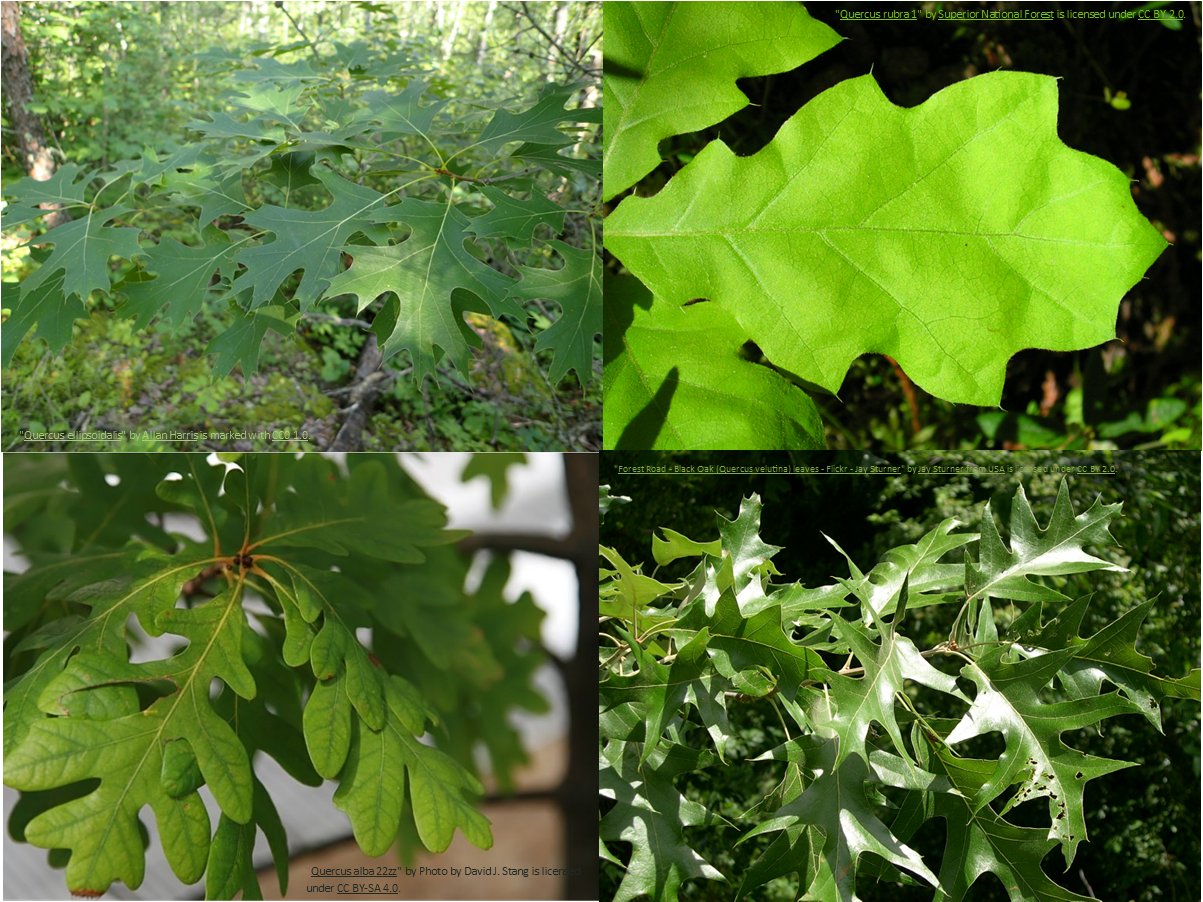
Oak leaves clockwise from top left: Northern pin oak, Northern red oak, black oak, and white oak
Guest Column Article for Alpena News by Dr. Greg Corace of the Alpena-Montmorency Conservation District
No other tree species group elicits more interest in northeastern Lower Michigan than do oaks. More specifically, landowners ask: what is killing oaks and what can be done to address this issue?
Because I work with forest ecosystems and do not perform the duties of a landscaper or arborist, I suggest that the forest landowner think broadly in space and time about their entire forest and first understand how and why the landscape of northeast Lower Michigan has changed since European settlement. Acknowledging the past and the processes that have led to where we are prepares one’s mind to understand potential pathways of future forest adaptation in a changing climate.
To begin, one needs to know our oak species and the ecosystems they inhabit.
There are four oak species that are common to northeastern Lower Michigan: Northern pin oak or Hill’s oak (Quercus ellipsoidalis), Northern red oak (Quercus rubra), white oak, (Quercus alba), and black oak (Quercus velutina). Scattered bur oak (Quercus macrocarpa) and swamp white oak (Quercus bicolor) can also be found, with specimens of both species likely the result of plantings.
Interestingly, oaks hybridize readily. According to Michigan Flora (https://www.michiganflora.net/) northern pin oak, for instance, can have traits that vary across a relatively broad spectrum of characteristics due to hybridizing with other oak species. It is not always easy to know what oak species one is dealing with.
Where can these species be found?
Much of the natural world exists on gradients. For instance, soils can be drier or wetter; less productive or more productive. Different oak species have evolved to do better at different points on ecological gradients.
On our driest sites with nutrient-poor sands, northern pin oak grows among jack pine. This species should not be confused with pin oak (Quercus palustris), which is found on more productive soils farther south. Some white oak and black oak may also be found on our driest sites.
On sites that are moister and a bit more productive, Northern red oak, white oak, and black oak are found. Compared to Northern pin oak, these species can grow on a broader range of soil types and can be found mixed with red pine, Eastern white pine, or species more typical of northern hardwoods: sugar maple, yellow birch, and Eastern hemlock.
Historically, disturbances (e.g., fire, windthrow, insects) of different severities (lethality to plants) served to promote and maintain oaks. As a group, oaks are shade-intolerant; they require more sunlight than many other tree species, and disturbances give them access to sunlight. However, before northeastern Lower Michigan was settled by peoples of European decent, oaks were a relatively minor component of our forests. The abundance of oaks now observed was initiated by the “Great Cutover”, or the broadscale, unsustainable logging of our forests in the late 19th and early 20th century.
In a classic forest ecology paper (Journal of Ecology 1987 75:667-684) data indicated that unnatural fires fueled by logging debris in the early 20th century, and the removal of pines that can only reproduce by seed, promoted the dominance of stump-sprouting species such as aspen and oaks. A more recent paper (BioScience 2008 58:123-138) illustrated how fire suppression throughout the latter half of the 20th century further changed these ecosystems, a process termed “mesophication.” Unsustainable logging created the conditions that we now have and altered fire regimes and traditional forest management help to maintain these conditions.
From an ecological perspective, many of our current conditions of oak-dominated forests do not have a natural model for ecologically sustainable management. Relative to patterns quantified in more naturally complex forests, our oak-dominated forests tend to have fewer tree species and are more simplified in structure.
What is oak decline?
Oak decline is a broad-scale condition whereby many stressors of oaks act individually or in concert to cause mortality. The next article in this series will discuss the complexity of oak decline and how landowners might address related issues so as to promote conditions that will promote resilient and resistant forests for the future.
Greg Corace is the forest and wildlife ecologist for the Alpena-Montmorency Conservation District. For more information, including assistance with forest planning and management, email Greg: greg.corace@macd.org.