More Thoughts on Forest Restoration
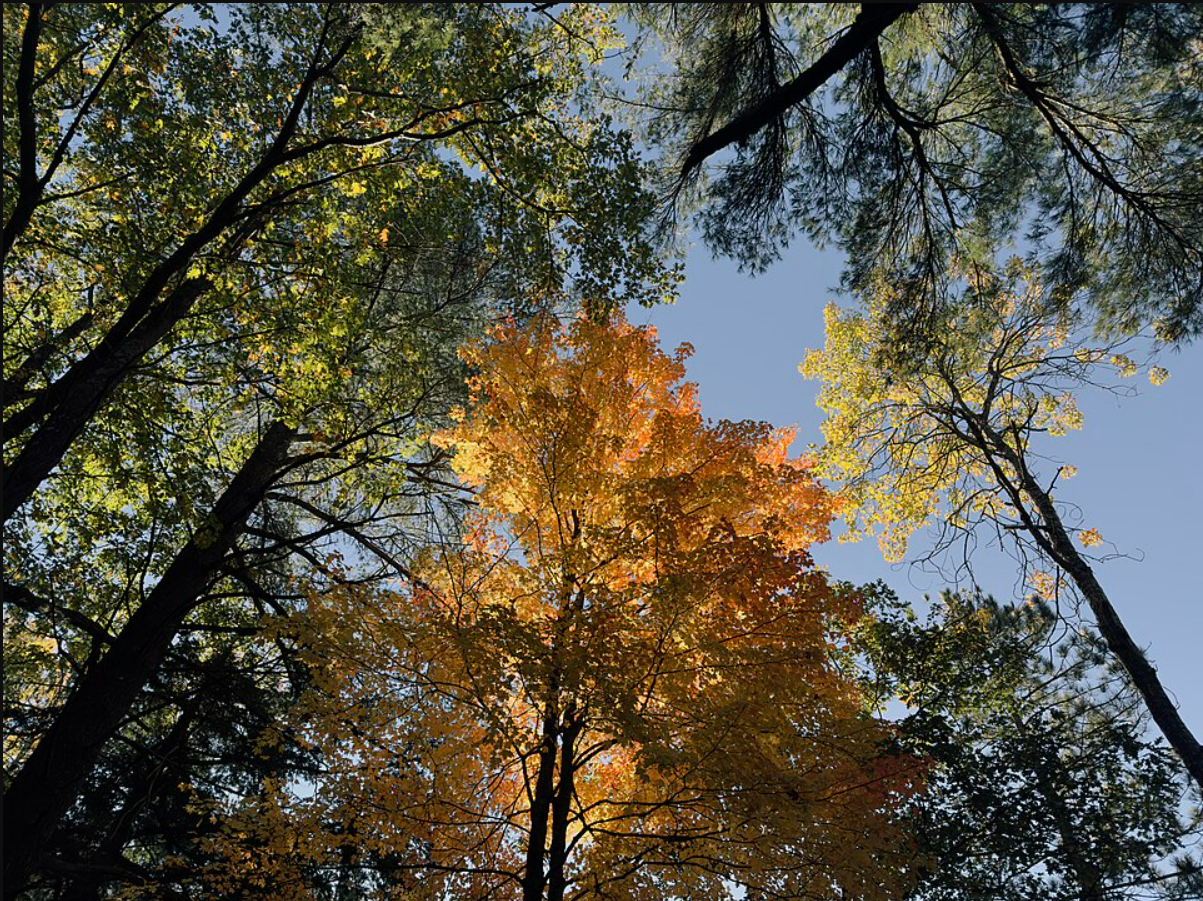
"Huron National Forest Big Trees MI" by Zapatosunidos is licensed under CC BY 4.0.
Guest Column Article for Alpena News by Dr. Greg Corace of the Alpena-Montmorency Conservation District
Restoration, as defined by the Society for Ecological Restoration, is management to, “initiate or accelerate ecosystem recovery following damage, degradation, or destruction” (see SER.org). Forest restoration can be directed at composition (plant species mix), structure (arrangement of dead or live vegetation among layers of the forest), and/or processes that maintain forests (e.g., hydrology, fire, windthrow, etc.).
Restoration, as a human endeavor, is not about perfection as much it is about dealing with management tradeoffs. For instance, some forests have little browsing pressure, few invasive species, and a mix of native plant species of different size classes and life stages. These forests (often in public ownership) may have a relatively high degree of ecological integrity. As such, there may be few tradeoffs. Restoration, if a landownership goal, may aim for aspects of benchmark forests of pre-European condition, with an overall understanding of management as a “working hypothesis.”
Conversely, in most forests, browsing pressure, invasive species, and other challenges may hinder restoration to benchmark standards. Tradeoffs are common in these instances. One can’t have it all. Management can still be restorative, however, albeit in fewer ways. If deer browse limits restoring all native plant species, for instance, focus efforts on restoring only plant species that are less likely to be browsed. Similarly, if a forest has little deadwood that drives biodiversity, focus on providing ruffed grouse drumming logs or standing dead trees (snags) in the overstory for cavity-nesting species of birds and mammals and a myriad of other associated organisms.
To paraphrase Winston Churchill, don’t let perfection be the enemy of forest restoration.
Regardless of the pre-restored condition, the concept of “natural range of variation” can be a useful guide (1999 Ecological Applications v.6, p.1179+). For most forest ecosystem types at different points of forest development, science has provided estimates of expected values associated with composition and structure. As such, forests can be evaluated along a gradient of “more in line with natural variation” or “less in line.”
For instance, a red pine plantation with trees in rows and all of one age and size class is less in line with the natural range of variation of red pine-dominated forests (2008 Forest Ecology and Management v.256, p.1723+). These plantations are less complex than their natural counterparts that have 2-3 age classes of red pine, other tree species mixed in, and scattered deadwood. Fortunately, complexity can be a focus of management and be restorative.
In plantations growing on appropriate soils, restoration towards a more natural range of variation might occur by conducting harvests to produce openings of irregular shapes and sizes for recruitment of new plant species or new age classes of red pine. Harvest equipment can also cut some trees to be left on the forest floor or girdle other trees to be left standing in the canopy. Both actions provide deadwood for biodiversity.
Restored forests of greater complexity may also be better adapted for climate change. For instance, forests of aspen or “popple” were historically rare in northeastern Lower Michigan, but increased in abundance due to human activity in the 20th century. Because climate change models suggest that the aspen species group will likely do poorer in a warming climate, restoration of past conditions may provide complexity and a greater ability for the forest to adapt overall. More specifically, restoration could focus on plant species which are likely better adapted for a warmer climate and have been displaced by the aspen. White oak and eastern white pine are two tree species that are less common now and which climate models suggest will do well in the future.
Finally, on some sites, browsing pressure, invasive plants, and other stressors are so great that it is unlikely any forest can be produced in the near future that falls within any natural range of variation. Such forests could be referred to as “novel ecosystems” (2009 Trends in Ecology and Evolution v.24, p.599+). We will explore this topic in future articles.
Greg Corace is the forest and wildlife ecologist for the Alpena-Montmorency Conservation District. For more information, including assistance with forest planning and management, email Greg: greg.corace@macd.org.