
What Do Woodpeckers Tell Us About Forests?
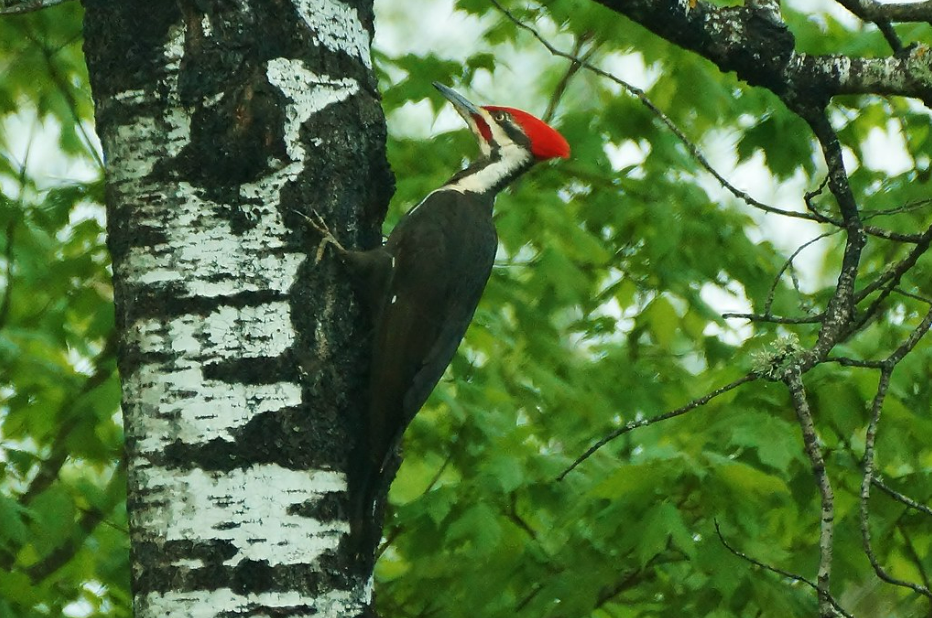
"Pileated Woodpecker" by chumlee10 is licensed under CC BY-SA 2.0.
Guest Column Article for Alpena News by Dr. Greg Corace of the Alpena-Montmorency Conservation District
A more subtle appreciation of the natural world is required during the winter in northeastern Lower Michigan, especially for birders. Gone, for example, are most of our songbirds, waterfowl, marsh birds, and shorebirds that inhabit the array of ecosystems found in the region.
Nonetheless, the black-capped chickadee, tufted titmouse, blue jay, members of the winter finch species group, and a couple species of woodpeckers still provide winter viewing enjoyment. Woodpeckers, in particular, are of note because many are conspicuous.
Nowhere else in Michigan are more woodpecker species found than in northeastern Lower Michigan. According to the Michigan Breeding Bird Atlas II (2013), there are at least seven (and maybe eight!) breeding woodpecker species (https://naturecenter.org/conservation/research/mbba/).
The downy and hairy woodpecker are two of the more common, year-round species and are similar in appearance; the slightly larger hairy woodpecker is distinguished by a more robust bill. Like many other species of woodpeckers, the males have redder heads than the females. Both species inhabit deciduous and coniferous forests. Like many woodpeckers, they forage mostly on insects, many of which are exotic or native tree pests (e.g., gypsy moth, spruce budworm).
The pileated woodpecker is the largest woodpecker species found in Michigan and a year-round resident. During the Great Cutover of the late 19th and early 20th centuries, this species was considered table fare in logging camps. Now, protected from hunting, this common species is a posterchild for forest recovery (see Michigan Breeding Bird Atlas I, 1991. p.37+).
Pileated woodpeckers are large and robust and their excavations in living and dead trees are important to many other wildlife species that are unable to make cavities. A study published in the Journal of Wildlife Management (2000. v64, p.52+) found 18 wildlife species using cavities produced by pileated woodpeckers over a 5-year period in one locale in Canada.
The red-bellied and red-headed woodpeckers make short-distance migrations south during the winter, with some scattered individuals still braving the cold. The male red-headed woodpecker is stunning. During short flights it shows off large patches of white in its wings that contrast markedly with the black on its body and the brilliant red head. The red-headed woodpecker is of relatively high conservation concern with populations declining markedly for decades in many parts of the more agricultural Midwest.
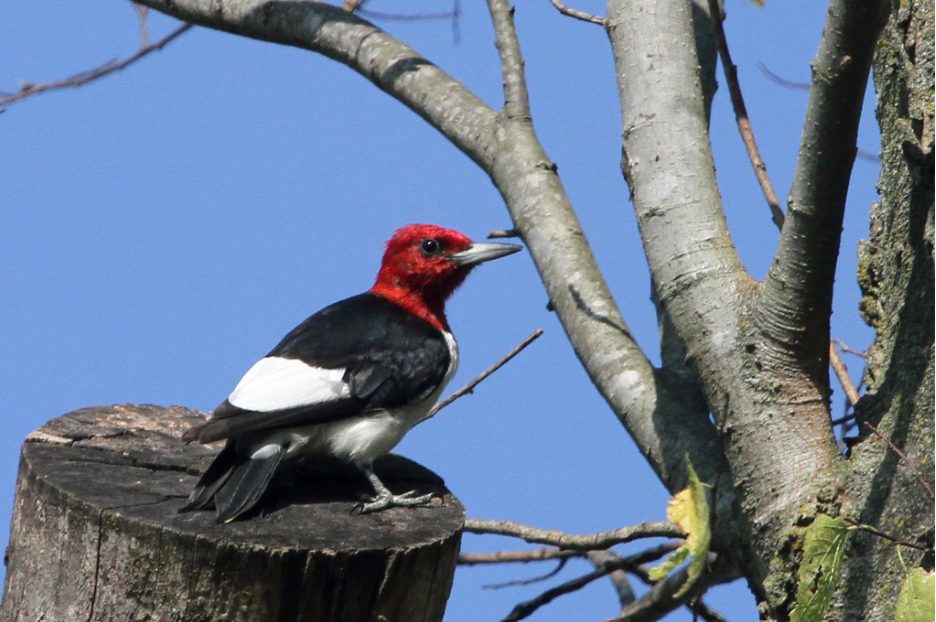
"Red-headed Woodpecker" by Greg Schechter is licensed under CC BY 2.0.
The northern flicker and the yellow-bellied sapsucker are two woodpecker species that are long-distance migrants. The northern flicker is known for eating ants. And the male yellow-bellied sapsucker is known for having a call that sounds like a cat “mew.” As the name suggests, yellow-bellied sapsuckers add tree sap to their diet and use their long tongues to extract sap from the line of small holes that they put around a tree.
What do woodpeckers tell us about our forests?
Woodpecker diversity corresponds with the diversity in tree species and forest types found regionally or on a given property. Woodpecker diversity also indicates the important role played by natural disturbances like fire, windthrow, and insect defoliations. Dead and dying trees produced by disturbances are important to woodpeckers and a myriad of other species of plants and animals. For instance, fire-maintained pine forests are inhabited by the uncommon black-backed woodpecker. While the status of this species in the Lower Peninsula is uncertain, scattered populations are found in the Upper Peninsula where it takes advantage of the abundance of insects and their larvae that occur after a fire.
Woodpecker diversity also tells us something about the structure of our forests, including the size of trees. One cannot have pileated woodpeckers breeding in forests if trees are too small in diameter to fit a nesting adult!
Conserving complex forests that emulate natural patterns in structure and composition, and the disturbance that maintains these patterns, are beneficial to woodpeckers and a diversity of other species. Forest management must take into account complexity and create or maintain an abundance of live, dying, and dead trees, of all sizes and scattered in clusters across a harvested stand, to maintain this biodiversity.
Greg Corace is the forest and wildlife ecologist for the Alpena-Montmorency Conservation District. For more information, including assistance with forest planning and management, email Greg: greg.corace@macd.org.