Singing Male Frogs and Toads Welcome in an Early Spring
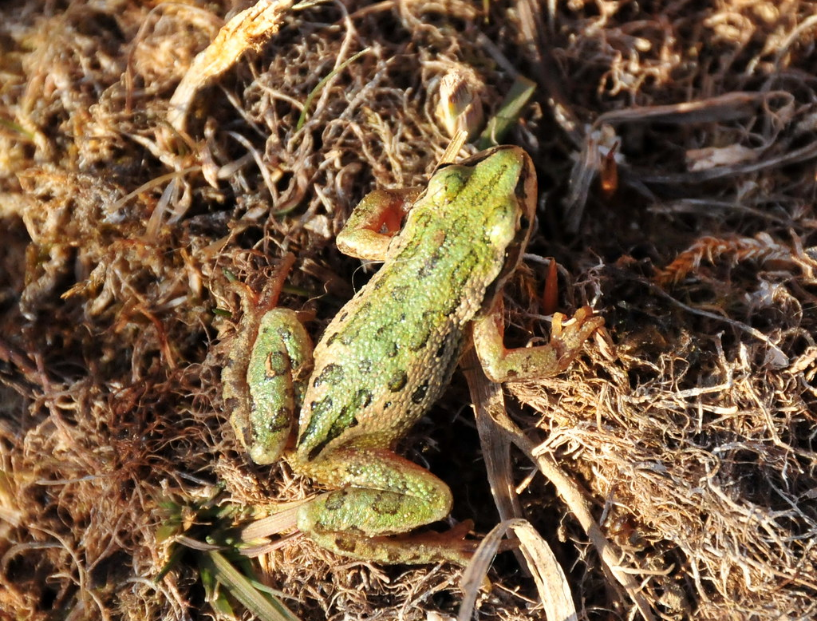
"BOREAL CHORUS FROG (PSEUDACRIS MACULATA) Seedskadee NWR" by USFWS Mountain Prairie is licensed under CC BY 2.0.
Guest Column Article for Alpena News by Dr. Greg Corace of the Alpena-Montmorency Conservation District
With the (oddly) early spring that seems to be on its way, I can’t help but anticipate our local phenology in northeastern Lower Michigan. Phenology is the study of cyclical (repeated) natural events. For those with a sugarbush, the flow of tree sap in late winter is one such phenological event. Sap flows every year to different degrees as energy stored in a tree’s root heads towards soon-to-be growing tissues.
Another phenological event is one that brings an assortment of sounds to our wetlands and forests: the mating rituals of different species of frog and toad.
Each species of frog and toad has temperature cues that trigger the males of the species to sing in search of mates. Two of the earlier species to sing each year should be vocalizing soon: the wood frog and the spring peeper. For those lucky enough to have a small wetland or wet spot in their forest that dries up later each year (called a vernal pool), these two species are the harbingers of spring.
As late winter officially gives way to spring and temperatures rise, other frog species take center stage. Some of these species include the chorus frog, leopard frog, pickerel frog, green frog, mink frog, and gray and/or Cope’s treefrog. By the time summer rolls around, the American bullfrog and American toad dominate the warm evening chorus.
Amphibians, such as frogs and toads, are good indicators of some environmental and ecological conditions. Now seemingly defunct, the Michigan DNR led a long-running survey of frogs and toads using their phenology and the distinctive song of males of each species to produce indices of populations. For this former surveyor, the frog and toad survey provided many evenings of listening enjoyment.
What can a forest landowner do to conserve vernal pools?
Many species of plants and animals utilize vernal pools. Because these depressions in the forest are not connected to creeks or streams, they are without fish. Therefore, many organisms are free from fish predators. Frogs and toads are but a few of the organisms that benefit from vernal pools. Many other species of invertebrate and vertebrate, as well as plants and fungi, can be found in and around vernal pools.
Identifying vernal pools is the first step in their conservation. This is best done during the late winter/early spring or late fall, when forests are their wettest. The irregular depressions that make up vernal pools will be easily observed as there will be more standing water in the vernal pool depression than the surrounding forest.
Once a landowner finds a vernal pool, the next step would be to demarcate its boundaries. A little pink or orange flagging tied to trees around the periphery of the vernal pool should be sufficient. From that point forward, it is best to minimize any impacts to the vernal pool: keep motorized equipment out of it, don’t try to plant other vegetation or cut vegetation in it. Rather, allow the vernal pool to develop its own complexity from naturally developing brush piles or downed wood that will be used by frogs, toads, and other species.
Once protected, a vernal pool will likely provide many years of spring and summer listening pleasure.
For more on the former frog and toad survey see: www.interlochenpublicradio.org/2023-05-05/to-volunteers-dismay-michigans-frog-and-toad-survey-is-put-on-hold.
More about frogs and toads in Michigan, including audio files of their vocalizations, can be found here: https://www.michigan.gov/dnr/education/michigan-species/reptiles/frogs-and-toads
More about Michigan vernal pools can be found here: https://www.youtube.com/watch?v=QSBsnwFPBFo
Greg Corace is the forest and wildlife ecologist for the Alpena-Montmorency Conservation District. For more information, including assistance with the Qualified Forest Program and related forest planning and management, email Greg: greg.corace@macd.org.