Forest Recovery
Guest Column Article for Alpena News by Dr. Greg Corace of the Alpena-Montmorency Conservation District
Different forest types are adapted to different ecological disturbances. A disturbance, from an ecological perspective, is anything that alters the amount or arrangement of biomass (organic material). A timber sale is an ecological disturbance, as are animal herbivory, windstorms/tornadoes, or fires. All these events alter biomass and can change the composition (species assemblage) or structure (vegetation arrangement) in a forest over decades or centuries.
Some disturbances are natural and native species have adapted to them. Other disturbances are more novel and challenging. It is ecological disturbances resulting from the impacts of exotic species or other alterations to the ecosystem that are of the greater concern for conservationists.
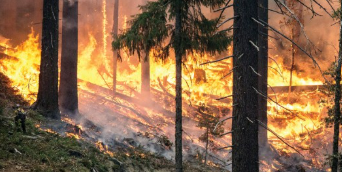
After winter dormancy, spring allows us to observe how forests respond to disturbances. Take, for instance, the Blue Lakes Fire of 2022. The fire occurred within forest ecosystems that are fire-dependent. The plants, animals, and other ecosystem components are adapted to fire. Many ecologists would suggest that fire suppression is really the greater conservation concern in these ecosystems. And nothing burned goes to waste.
I recently visited the Blue Lakes Fire area and evidence of the adaptive capacity of these forests was everywhere. First off, other than in the most severely burned areas, jack pine cones had been opened by the heat. Most of these cones had already released their seeds and some seed germination on the burned-over soil should occur soon. How much? Time will tell.
Blueberries, other native ground flora, and resprouting cherry trees were also observed in abundance. The fire will likely lead to many fruit crops in the near future, something humans and many wildlife species will enjoy.
Finally, I was reminded of some past research published in the journal Forest Ecology and Management (2018, vol. 408, pg. 103-1011) that documented the tendency of fires in these ecosystems to not kill all trees, but leave “stringers” or patches of burned, live trees behind. Not surprisingly, I observed a number of patches of live jack pine and red pine.
These residual forest patches provide a refugia for many plants and animals. A different paper in the same journal documented the role these stringers play in providing habitats for different bird species throughout the year (2014, vol. 331, pg. 93-103). I can only wonder if the quintessential, fire-dependent Black-backed Woodpecker is found within the burn perimeter or nearby. This species is much less common in Lower Michigan than it is in Upper Michigan. It needs relatively large, burned trees to nest and represents one of the species negatively impacted by overzealous salvage logging.
Another example of forest recovery can be seen by the response of our deciduous forests to the herbivory of the larvae of the exotic gypsy (spongy) moth. The population outbreak of moths was understandably a topic of exceptional interest during the past few years. Some private lands received pesticide treatments in response. As far as I know, however, public lands were not treated.
This spring, I’ve found very few moth egg masses, regardless of whether I’ve been on private or public land. Consequently, it seems spraying was not a panacea. Natural predators and pathogens of the moth probably took their toll and reduced moth populations more so than any spraying.
Area forests have (in most instances) responded to the herbivory of this exotic species fairly well. Predictably, energy reserves stored in the roots of healthy deciduous trees provided the necessary resources for resprouting.
Forests in northeastern Lower Michigan are being stressed in many ways. Those managing forests need to be mindful that we cannot ignore the evolutionary or geological forces that have shaped these ecosystems. While forests are adapted to recover from some ecological disturbances, there are others that are more challenging (e.g., oak wilt, emerald ash borer). We need to pick our battles and not overreact to every change we see in a forest. The key to conservation is understanding the natural complexity of forests as described in the scientific literature and use this information to guide our management.
Greg Corace is the forest and wildlife ecologist for the Alpena-Montmorency Conservation District. For more information, including assistance with forest planning and management, email Greg: greg.corace@macd.org.